See how AI medical-record review links every fact to the exact Bates page that proves it — click any citation and jump straight to the record.
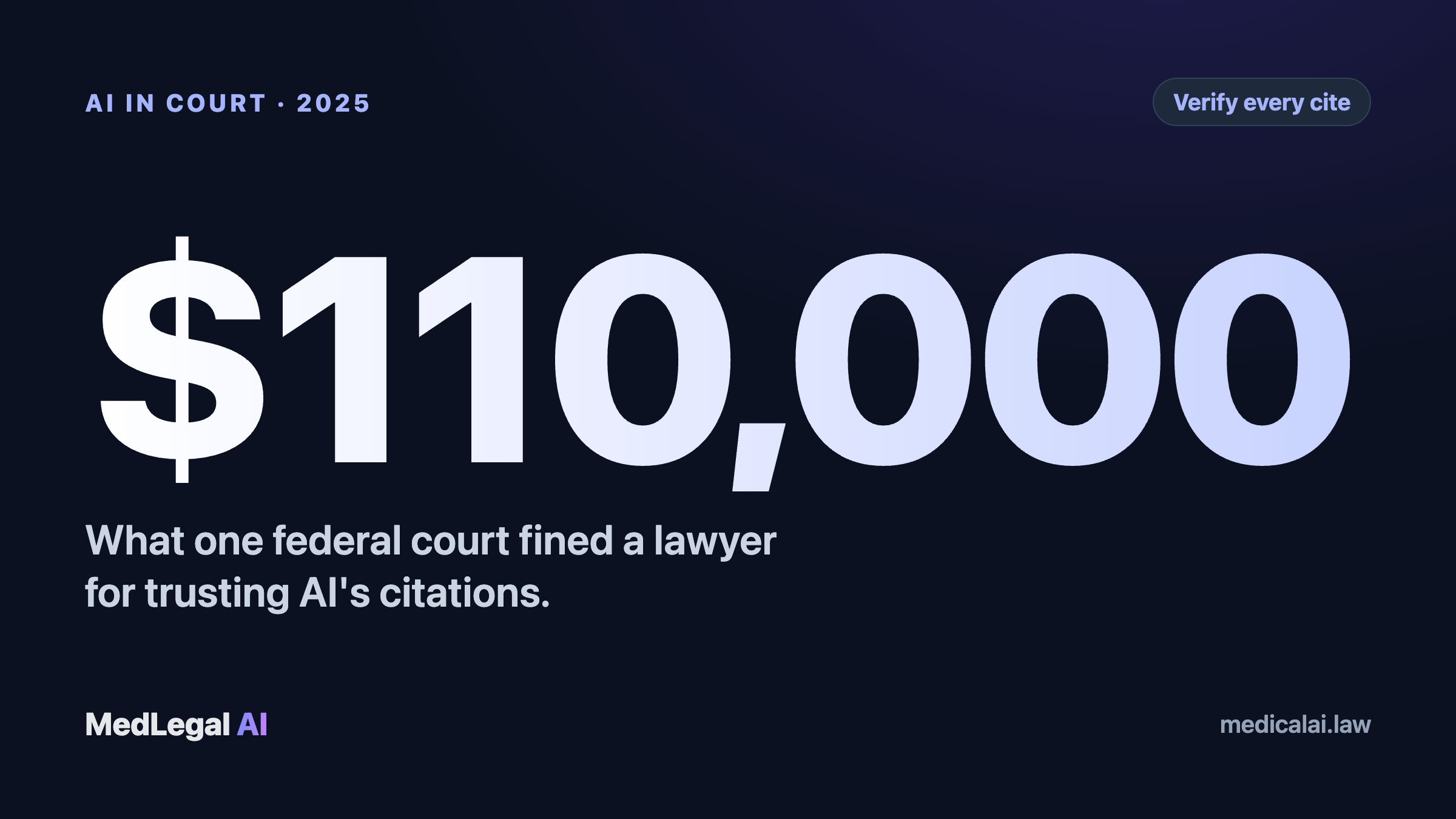
See the 60-second demo →Last week, a Pennsylvania attorney narrowly escaped sanctions after submitting AI-generated citations to a federal appellate court. The citations looked real. They cited actual legal concepts. They had proper formatting. There was just one problem: the cases they cited didn't exist.
A colleague objected. The judges — already seeing a pattern of this — issued a light punishment. The attorney was lucky.
This is not an isolated incident. It is becoming a pattern. And for attorneys handling medical malpractice, personal injury, and healthcare fraud cases, the risk isn't just about citations. It's about every factual claim extracted from a medical record.
To understand why this keeps happening, you need to understand how large language models actually work.
These models don't retrieve facts from a database. They predict the most statistically likely next word, over and over, based on patterns in their training data. This makes them excellent at writing fluent sentences. It makes them dangerous when you need verifiable accuracy.
When an attorney asks a general AI tool, "What cases support our expert's opinion on the standard of care for post-op monitoring?" the model doesn't look up cases. It generates text that sounds like a case citation. It has a realistic-sounding name, a plausible court, a plausible year. The model has no mechanism to say "I don't know" — so it produces something that looks like an answer.
The Pennsylvania case is a textbook example. The attorney trusted the output. The opposing counsel didn't. The court noticed.
Citation hallucination gets the headlines. But for PI and med-mal attorneys, the real risk is buried in medical records — and it's harder to catch.
Consider a typical scenario: a client with a spinal injury produces 4,000 pages of records from three hospital systems, two physical therapy providers, and a pain management clinic. Your paralegal uses a general AI tool to summarize the records. The summary reads cleanly. It mentions all the right diagnoses. It references the key dates. What it doesn't mention — because the AI skimmed past it or weighted it as low-probability — is a single nursing note on page 1,847 documenting a fall that happened after the initial accident. That note is the defense's entire case.
Generic AI tools aren't built to flag what they don't know. They're built to produce smooth summaries. In medical record review, smooth summaries that omit critical details are a form of hallucination — just a more subtle one.
"The problem isn't that AI is wrong. The problem is that AI is wrong confidently. And in court, confidence without accuracy is malpractice waiting to happen." — medicalai.law team
As demonstrated in Pennsylvania and dozens of other cases, general AI models generate authoritative-sounding facts that are simply invented. In medical records, this shows up as invented lab values, fabricated procedure dates, and synthesized physician statements that never appeared in the original record.
The model doesn't know it's wrong. It produces the most statistically plausible answer. When you're dealing with the exact CPT code billed, the exact dose administered, or the exact time documented in a nurses' note, "statistically plausible" isn't good enough.
Long-document processing is one of the most failure-prone areas for general AI tools. Models have context windows — limits on how much text they can hold in working memory at once. When they process a 4,000-page document, they don't "read" all of it with equal attention. Important details in the middle of long records are frequently omitted from summaries.
For a medical record review, that means the pre-existing condition buried on page 200, the adverse drug reaction noted in the pharmacy record, or the conflicting diagnosis from the consulting neurologist may never surface. Your summary looks complete. Your case strategy is built on incomplete information.
Medical records are full of clinical shorthand, CPT billing codes, ICD-10 diagnostic codes, procedure descriptions, and pharmaceutical notations that require domain-specific knowledge to interpret correctly.
A general AI tool might correctly transcribe "CPT 93306" from a record but fail to flag that this code was billed twice in the same day — a classic double-billing pattern that signals either medical billing fraud or a clerical error worth $2,000 in overbilling. Without a billing-specific framework trained to recognize coding anomalies, the AI reads the number without understanding its significance.
The distinction isn't just about one AI being smarter than another. It's about architecture, purpose, and verification.
Specialized medical-legal AI tools are built from the ground up to do specific jobs:
Courts are paying attention. After a wave of sanctions in 2023 and 2024, federal judges in multiple circuits have issued standing orders requiring attorneys to certify that AI-generated content has been verified by a licensed attorney. Some judges now require disclosure of any AI tool used in brief preparation.
Bar associations have been slower to move, but disciplinary guidance is coming. Several state bars have issued ethics opinions making clear that the "supervised practice" obligations that apply to associate attorneys apply equally to AI tools. If the AI gets it wrong and you submitted it, you are responsible.
The attorney in Pennsylvania was lucky — a light sanction, a learning moment. The next case in her state may not be so lenient. In jurisdictions where judges have been explicit about the rules, attorneys who continue using unverified AI output face potential contempt findings, fee forfeiture, and bar referrals.
The answer is not to avoid AI. Used correctly, AI dramatically reduces the time and cost of medical record review. The answer is to use it correctly.
We built medicalai.law for exactly this problem. Not general-purpose AI that improvises answers — purpose-built tooling for PI and med-mal attorneys who need to move fast without getting burned.
Our medical records review tool extracts findings with source links. Our billing analysis engine flags CPT coding anomalies, duplicate billing, and upcoding patterns against known fraud signatures. Every output is tied to the source record. We don't confabulate — we extract, flag, and cite.
The PA attorney who got sanctioned was trying to work faster. We get it. Every attorney handling medical cases faces the same pressure — too many records, too little time, too much riding on getting it right. The answer isn't to use tools that move fast and get it wrong. The answer is tools purpose-built to move fast and get it right.
Upload a sample medical record or billing document. We'll show you exactly what our system flags — with source citations, not confabulation.
Try MedLegal AI Free →The Pennsylvania case is a preview of where this is heading. As more attorneys adopt AI tools, the gap between those using general tools carelessly and those using specialized tools correctly will show up in outcomes — case results, sanction risk, client trust, and malpractice exposure.
Generic AI is getting lawyers sanctioned. Specialized AI is the alternative. The difference isn't just efficiency. It's the difference between a tool that helps you win cases and one that creates new ones.
The records don't lie. Your AI tools shouldn't either.
Related: Medical Billing Fraud: What Every PI Attorney Needs to Know | Physician Employment Contracts: What AI Catches That Humans Miss